Introduction:
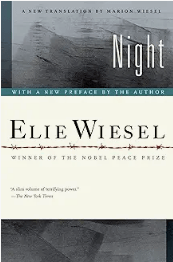
Night is a historical memoir by Elie Wiesel, published in 1956. This book follows Elie Wiesel’s Holocaust experiences in the concentration camps in Auschwitz and Buchenwald from 1944 to 1945, at the end of World War II. Wiesel portrays the pain and suffering many Jews had to go through, especially children at such a young age. Night is considered a famous novel, presenting a Jewish child’s perspectives in the wilderness of the excruciating Holocaust events.
Plot:
Elie Wiesel was living with his parents and his sisters, until one day he was interrupted by Hungarian soldiers, knocking on the door to inspect his father. In fear, he woke up the Jewish neighbors and families around them and prepared to flee his home. However, the Hungarian soldiers had gotten hold of them and forced them to be thrown into the dark and excruciating start of Holocaust experiences in the Auschwitz concentration camp. He was separated from his mother and sisters, but his father was next to him. They relied on each other during these agonizing times. They protected each other from the different challenges they faced to stay alive until the end of this war. However, many fatal challenges were coming before Wiesel, who tried everything to stay with and not die with his father. He had lost hope of finding his mother and sisters, assuming they were dead. When his father and Wiesel transferred their camp to the Buchenwald concentration camp, his father became ill. He tries his best to take care of him by giving him his portion of food and water, but his condition worsens every day. Prisoners around him kept telling him to save it for himself, but at last, his father passed away due to his disease. Becoming an orphan, Wiesel goes to the room with other kids without their families. He finally breaks free from the concentration camp when the guards are liberated at the end of the war. In the end, he looks at himself in the mirror and sees himself skinny and unfed and understands what this war did to him.
Analysis:
Through his memoir, Wiesel shows how extreme suffering shapes moral values and human relationships. One of the themes is the struggle to maintain faith, as Elie’s belief in God weakens while he witnesses innocent people endure endless cruelty by the soldiers. The novel also explores dehumanization, portraying how prisoners are reduced to numbers and stripped of dignity. Emotional numbness is frequently necessary for survival, and when self-preservation comes at the expense of empathy for others, guilt results. Elie and his father’s relationship exemplifies both love and moral conflict as devotion is put to the test by hunger, fear, and exhaustion. Wiesel illustrates how harsh circumstances change human behavior by contrasting acts of kindness with betrayal. Adding on, silence symbolizes the world’s failure to respond to injustice and suffering. The title of the book reflects both the physical darkness of the concentration camps and the spiritual darkness within Elie. Wiesel’s simple, direct writing style makes the events more haunting by refusing to soften their impact. Memory serves as an act of resistance, preserving the voices of those who were silenced. Ultimately, the book warns readers about the dangers of hatred and indifference while stressing the importance of bearing witness so that such pains are never forgotten.
Conclusion:
Elie Wiesel’s experiences during the Holocaust and his battle to endure unimaginable brutality are chronicled in Night. Elie sees the devastation of innocence and the breakdown of faith as he suffers from starvation, violence, and loss. Elie’s bond with his father serves as an example of how love and responsibility are put to the test in the face of great challenges. Wiesel demonstrates how dehumanization causes people to turn against one another in order to survive. In the end, the memoir is a significant tale of caution about consequences of hatred, silence, and apathy.
 Alicia kim's blog
댓글 남기기