Introduction:
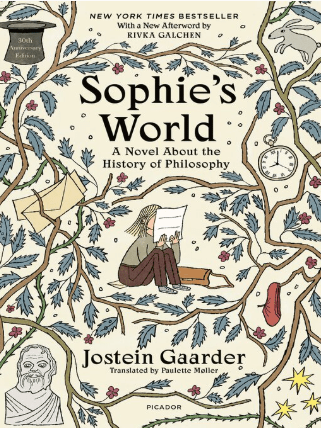
Sophie’s World is a philosophical fiction by Norwegian writer Jostein Gaarder, published in 1991. It is about a teenage girl named Sophie who begins receiving mysterious lessons on the history of philosophy, leading her on a journey through major philosophical ideas and thinkers. As she learns more, she discovers that she and her world are part of a book, sparking questions about reality, free will, and existence.
Plot:
A mysterious philosopher named Alberto Knox starts sending Sophie Amundsen, a teenage girl, strange letters and philosophical queries. Beginning with the ancient Greeks, such as Socrates, Plato, and Aristotle, and progressing through significant philosophical movements like the Enlightenment, Romanticism, and Existentialism, these letters slowly introduce her to the theories of well-known intellectuals. Sophie starts to wonder about the nature of reality itself as she gains more knowledge. She learns that she and Alberto are characters in a book that Albert Knag is writing for his daughter, Hilde. This insight provokes a more thorough examination of consciousness, free will, and the purpose of life. Alberto and Sophie attempt to take charge of their own lives and escape the author’s influence. Readers are taught key philosophical concepts in an easy-to-understand manner throughout the narrative. The book teaches that to understand life, one must think critically and ask questions. It also promotes the power of thought and curiosity. Ultimately, Sophie’s World is a narrative about finding your identity and purpose as well as an introduction to philosophy.
Analysis:
The narrative centers on Sophie Amundsen, a teenage girl from Norway who starts getting enigmatic letters with philosophical thought lessons. The novel progressively unveils a more profound, fictional layer as Sophie gains knowledge about philosophers ranging from Socrates and Plato to Kant and Marx. In a book written by Albert Knag for his daughter’s birthday, Sophie learns that she and her world are made up. This insight resonates with key philosophical themes explored throughout the book, challenging the notions of existence, reality, and free will. The book deftly illustrates how each philosopher advances or contradicts earlier theories by using Sophie’s education to trace the development of human thought. Sophie starts to doubt her creator’s authority as she realizes she is a fictional character and makes an effort to escape. Gaarder asks readers to consider the nature of reality and their own lives through this intricate story. The book pushes readers to examine not only philosophy but also their assumptions and beliefs critically. Through mystery and self-discovery, the story maintains its interest despite its philosophical depth. The characters, particularly Sophie and her instructor Alberto, act as accessible guides through difficult concepts.
Conclusion:
Sophie’s World is a philosophical fiction by Norwegian writer Jostein Gaarder, published in 1991. It is about a teenage girl named Sophie who receives mysterious philosophy lessons and eventually discovers she’s part of a book, raising questions about reality and existence. As she learns from the story, she discovers she is a character in a book written by someone else, leading her to question reality, free will, and existence. The novel blends philosophy with fiction, encouraging readers to reflect on their own beliefs and the nature of reality.
 Alicia kim's blog
댓글 남기기