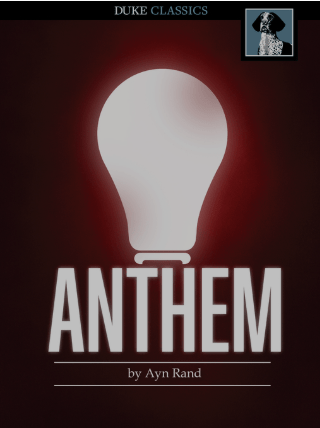
Introduction:
Anthem is a dystopian fiction novella written by Ayn Rand, a Russian-American author. It was written in 1937 but published in 1946 in the United States. The story starts out with the ordinary life of Equality 7-2521, a six-foot-tall male who had been assigned their designated duties and roles. Despite strict rules that limit the ability to carry out something, Equality 7-2521 broke many rules that were kept secret from the Council.
Plot:
On Earth, where innumerable years had passed and another Dark Age started, Equality 7-2521 is a six-feet-tall male who was raised in the Home of Students, where he dreamed of becoming a scholar. He often fought with others and was scolded for being too smart for his age. He couldn’t help but surpass the community’s standards. When he was finally graduating in the ceremony where the Council of Vocations assigns the graduating students, he was assigned as a street sweeper instead of a scholar. However, he wasn’t disheartened by this result; rather, he was uplifted to sin more and go further against the rules. During his journey as a street sweeper, he discovers electricity and invents a lightbulb, and decides to share this finding with the world. He also meets the Golden One, a beautiful peasant girl. Even though the rule of not talking to other “kinds”, he talks to her and falls in love. Before he has a chance to show his invention, he accidentally returns to the Home of the Street Sweepers late. When he refuses to tell where he was, he is thrown into the Palace of Corrective Detention, where he is tortured. He breaks out of the palace and goes to find the World Council to share his lightbulb and reconcile with his kin. However, the reaction was rather the opposite of what he had expected; the World Council threatens to kill him and destroy his invention, so he flees the city. He reaches the Uncharted Forest, where he finally becomes free of all of the restrictions. A few days later, he reunites with the Golden One, vowing to live together as one. They find a house in the Unmentionable Times where Equality 7-2521 dives into the meaning of ‘I’, a word that he was forbidden to say. He gets the courage to finally use the word. He vows to protect his home and start a new race that believes in individualism and the continuous dominance of ego.
Analysis:
The novella shows the development of Equality 7-2521 throughout his adventures. When he tells the stories of his childhood, it is visible that he tried to fit into society as he was isolated from friend groups. However, as the story went on, he became more daring and let his characteristics shine. He didn’t hesitate to break rules when needed, and was free in a limited area of strict rules. When he was chosen as a Street Sweeper, it was questionable as to why he wasn’t able to become a scholar, even if he was the smartest in the Home of the Students. His position in the dwelling of the students represents an outcast in society. His constant rule-breaking also represents an outcast, but also his free will. His action towards meeting the Golden One shows that although numerous centuries had passed, the attraction to the opposite gender is the same. The book also has symbolism. One of them is the light that Equality 7-2521 discovers, which symbolizes the hidden hope in the Dark Age. The book presents two themes of individualism versus collectivism and identity. The world that the author created shows collectivism rather than individualism through the Council’s political order. It also illustrates the process of Equality 7-2521 gradually coming to his identity with the word, ‘I’.
Conclusion:
Anthem is a dystopian fiction novella written by Ayn Rand, published in 1946. The story starts when countless years have passed into the future, and another Dark Age starts. Equality 7-2521 discovers electricity and invents a lightbulb. After being rejected by the World Council, he escapes to the forest with the girl he loves. There, he vows to rebuild a free society based on the word ‘I’ and focuses on the dominance of ego.
 Alicia kim's blog
댓글 남기기