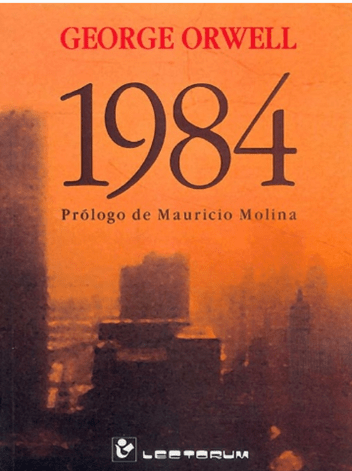
1984 Jan. 21, 2024
Introduction:
1984 is a dystopian novel written by George Orwell and was published in 1949. It has become one of the most classic political and dystopian novels. It is ubiquitously discussed in many schools as it is one of the most classic literary examples.
The Plot:
In 1984, the civilization was split into three provinces named Oceania, Eastasia, and Eurasia caused by world wars, conflicts, and revolutions. One of the super-states is Airstrip-One (former name: Great Britain) which is a part of the province called Oceania. In a country ruled by “The Party” with the idea of “Ingsoc” (a Newspeak word for English Socialism) and its leader Big Brother, they want everyone to follow their rules. They spy on people using telescreens and punish those who don’t obey. If someone goes against the Party, they disappear completely. Winston Smith lives in London and works for the government. His job is to change historical records to match what the Party wants people to believe. But secretly, Winston doesn’t agree with the Party and hopes for a rebellion, even though he could get in trouble for it. One day, Winston Smith goes to a neighborhood where regular people called “proles” live. There, he meets a man named Mr. Charrington, who owns an old stuff store. Winston buys a diary from him and starts writing his thoughts criticizing the Party and Big Brother. Later, Winston goes to another part of the neighborhood where proles live and realizes they don’t care about politics or rebelling against the Party. It disappoints him because he hopes to find allies in his fight against the Party. At work in the Ministry of Truth, Winston notices a woman named Julia. He suspects she might be a spy for the Party and starts hating her. He also thinks that his boss, a high-ranking Party member named O’Brien, might secretly be part of a rebel group called the Brotherhood, led by Emmanuel Goldstein, who is a rival to Big Brother. One day, Julia gives Winston a secret love note, and they start a hidden romantic relationship. Julia tells Winston that she also hates the Party, but he notices that she doesn’t care about changing the government. They meet in different hiding places. Later, Winston is invited to O’Brien’s place, where O’Brien reveals that he belongs to a rebel group called the Brotherhood. O’Brien gives Winston a book that explains how the Party stays in power, but Winston doesn’t get to read the part that explains why the Party wants to keep control. During a big event called Hate Week, the Party changes who the enemy is, but most people don’t notice. Winston is called back to work at the Ministry to change the records accordingly. He and Julia read parts of the book they got from O’Brien, which reveals the true meanings behind Party slogans and talks about wars. But Winston never finishes reading the chapter explaining why the Party wants to stay in power. Winston and Julia’s secret affair comes to an end when they are caught because Mr. Charrington turns out to be a spy for the Thought Police. They are taken to the Ministry of Love, where they are separately imprisoned. O’Brien reveals that he is a member of the Thought Police. O’Brien tortures Winston for months to make him believe in the Party’s ideas. O’Brien tells Winston that he will never know if the Brotherhood is real and that the book they read was written by Party members. In the end, to avoid more torture, Winston betrays Julia and pledges his loyalty to the Party. Winston is released and goes to a café where he meets Julia. They admit they betrayed each other and no longer love each other. Winston hears news about a victory and realizes he loves Big Brother.
Analysis:
In this book, the author mentions the German Nazis, the Soviet Union, and more. This shows that the author created a dystopian world with historical happenings around 1949. An important theme that can be found in this story is nationalism. In the novel, Winston symbolizes both positive and negative nationalism. He didn’t support the Party and Big Brother and wanted to rebel against them. However, O’Brien tortured him to change his mind about the Party and Big Brother. The author also shows his thoughts about the future. In the novel, he presents the setting as a futuristic but negative utopia. The novel can be seen as his nightmare vision of the future as he was inspired by the happenings around the world when he started writing the novel. Another theme that represents the novel is surveillance. In the world of Orwell’s imagination, the “proles” doesn’t have any privacy. They are tracked and recorded with a telescreen 24/7. Any human is supposed to report when seeing something unusual or illegal and citizens are controlled. Winston was the only character who strongly disagreed with the Party. Even if Julia also disagrees with the Party, it is said Julia didn’t care about changing the government. Big Brother can be seen as a symbol of surveillance but also ultimate power. No one knows him and no one can overthrow him. He is constantly watching the telescreen and controlling Oceania as a leader. Newspeak is a new language that usually is a shortening of an Oldspeak. (which is the standard English we are speaking)
Conclusion:
1984 is a dystopian novel that is also a classic of negative utopia written by George Orwell. It became one of the most famous political dystopian novels in the world. This novel is also thoroughly discussed in many schools. The novel holds many themes such as surveillance, nationalism, and more. It is also considered a novel based on the history of that time. The book describes a world that the author saw as a nightmare. It shows that themes are crucial in the world of society and the world we live in.
 Alicia kim's blog
댓글 남기기